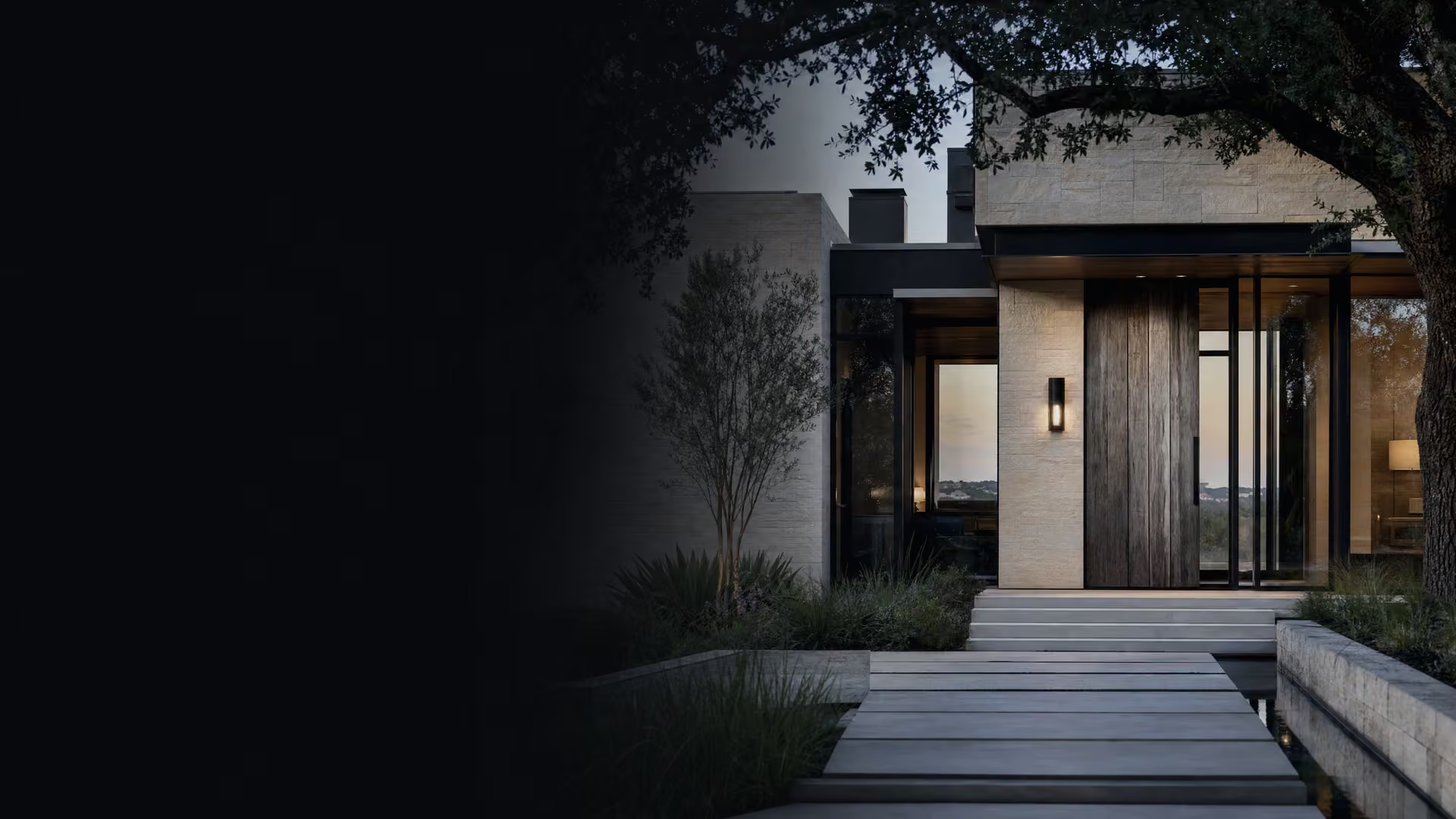
AUSTIN · WEBSITES FOR BUILDERS
Your work already belongs in Westlake. Your website should look like it.
Built in Austin for owner-led builders, pool contractors, landscapers, and outdoor-living firms serving high-value residential projects.
A real Austin studio contact, without invented neighborhood work
The short answer
What should Austin builder web design communicate?
Austin builder web design should reflect the market the company is trusted to work in: strong architecture and project photography, clear services, credible local coverage, and an inquiry path calibrated for high-value residential work. The site should feel appropriate for a referral in West Lake Hills or Tarrytown without pretending that local keyword repetition is a substitute for excellent work.
Local footprint
Built for the broader Austin market
Coxswain builds websites for contractors and builders serving West Lake Hills, Rollingwood, Tarrytown, Pemberton Heights, Barton Creek, Spanish Oaks, Lakeway, and Bee Cave. The page structure is designed to make the service area clear without turning the website into a directory of duplicated city pages.
- 01West Lake Hills
- 02Rollingwood
- 03Tarrytown
- 04Pemberton Heights
- 05Barton Creek
- 06Spanish Oaks
- 07Lakeway
- 08Bee Cave
- Comfort with limestone, modern architecture, outdoor living, pools, and complex sites
- Different project language for central Austin estates, Westlake custom work, and Lake Travis-area projects without stereotyping
- Heat, shade, water, and outdoor-living photography considerations
- Precise service boundaries instead of keyword lists
- Verified local project naming where the contractor has permission
- Budget, neighborhood, timeline, and project-type qualification
Signature inspection
What an Austin high-end residential website needs to communicate
The market note connects local material and site conditions to the way the website presents proof.
- LIMESTONE
Material judgment
Texture and edge detail matter across architecture, pools, retaining work, and outdoor rooms.
- HEAT + SHADE
The site explains comfort
Canopy, orientation, glazing, water, and shaded living are commercial evidence, not decoration.
- COMPLEX SITES
Terrain stays legible
Grades, views, drainage, access, and retaining conditions belong in project stories.
- SERVICE AREA
Coverage without theater
The site names the market precisely and never implies unverified local projects.
- QUALIFICATION
Project fit comes first
Neighborhood, type, budget, timeline, and readiness make the inquiry useful.
Austin evidence
A studio here, and work labeled exactly for what it is
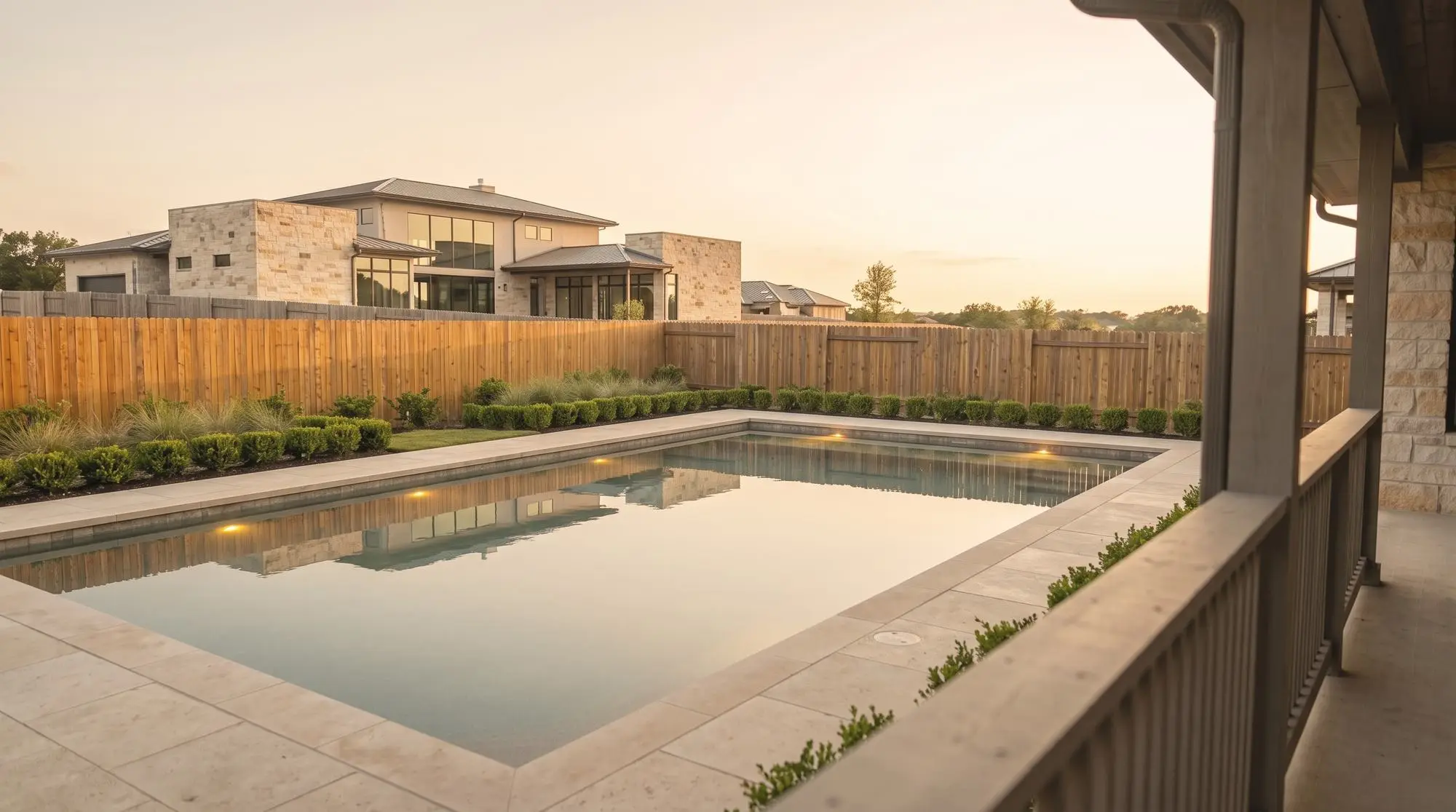
Studio showpiece · Austin pool builder
Stillwater Pools & Outdoor
Water, material detail, local positioning, and a qualified project path.
The page should feel local before it names a place
- Texas limestone and material restraint
- Live-oak shade and orientation
- Pools and complete outdoor living
- Modern and established residential contexts
- Grade, drainage, and complex access
- Lake and hill relationships
- Precise service coverage
- No invented neighborhood portfolio
Eight dimensions
The Austin builder website standard
- 01
Austin positioning
Does the site identify the trade and level of Austin residential work?
- Weak
- Generic Texas construction language.
- Strong
- Specific project types, materials, and market fit.
- Fix
- Lead with the work and buyer, not the city keyword.
- 02
Local project presentation
Are locations and site conditions used carefully?
- Weak
- Neighborhood names without evidence.
- Strong
- Verified location language and relevant project context.
- Fix
- Publish only locations the contractor can substantiate and clients permit.
- 03
Material relevance
Does photography reveal limestone, timber, steel, water, and concrete?
- Weak
- Oversaturated wide shots.
- Strong
- Material and transition details support the wide view.
- Fix
- Pair each elevation with craft and site-condition details.
- 04
Service-area precision
Can buyers distinguish Austin, Westlake, and Lake Travis-area coverage?
- Weak
- An undifferentiated metro list.
- Strong
- Coverage is described by real operating fit.
- Fix
- Use one composed footprint statement and avoid cloned locality pages.
- 05
Climate and site proof
Does the work address heat, shade, grade, drainage, and water?
- Weak
- Architecture floats without site context.
- Strong
- Project stories explain how the property shaped the solution.
- Fix
- Add one practical site decision to every featured project.
- 06
Trust evidence
Are team, reviews, process, and credentials specific?
- Weak
- Generic local-expert claims.
- Strong
- Attributable proof and named responsibility.
- Fix
- Replace broad local claims with direct operational evidence.
- 07
Project qualification
Does the inquiry establish neighborhood, type, budget, and timing?
- Weak
- A blank quote request.
- Strong
- The first response can assess real fit.
- Fix
- Collect only the Austin-specific variables that change feasibility.
- 08
Mobile execution
Does the site hold up in a referral's phone session?
- Weak
- Desktop media cropped by accident.
- Strong
- Independent phone composition and clear action.
- Fix
- Test at 390 pixels with video blocked and reduced motion.
Field questions
Austin market questions, answered without local theater
What should an Austin builder website include?
It should identify the builder's project types, real service area, design and preconstruction process, team, reviews, credentials, and inquiry requirements. Project pages should show architecture, materials, site conditions, and several useful views rather than one hero image. For Austin high-end residential work, limestone, shade, grade, water, and outdoor living often deserve specific treatment. Local wording must stay tied to verified capability and work, not an assumed neighborhood presence.
Do Austin contractors need separate pages for Westlake, Lakeway, and Bee Cave?
Not automatically. One strong Austin market page can state service coverage clearly. Separate pages are justified only when search evidence, project proof, site conditions, buyer decisions, and language differ enough to support original analysis. Copying the same page and changing Westlake to Lakeway or Bee Cave creates little value and can resemble a doorway strategy. Start with a coherent footprint, then use Search Console and real work evidence before expanding.
How should an Austin pool builder display projects?
Group by project and show the full outdoor environment: waterline, coping, plaster, relationship to the house, shade, grade, planting, decks, outdoor kitchens, and evening lighting. State whether the work was a new build or renovation and use location only at the level the client permits. Avoid oversaturated cyan water. Separate mobile crops and poster-first media help the details read without turning the page into a heavy video reel.
What is the best website platform for an Austin contractor?
The best platform depends on who maintains it and how much content it must support. Squarespace is a practical DIY choice for a focused small site. WordPress fits a content-heavy business with maintenance ownership. Webflow gives more design control but is rarely the simplest owner-managed option. A static Astro build suits a studio-led, performance-sensitive site with a clear handover. Platform choice follows operations; it does not replace positioning, proof, and project editing.
How much does a premium contractor website cost in Austin?
Austin does not create a special universal website price. Cost depends on strategy, copy, photography treatment, page count, forms, search architecture, integrations, launch, and maintenance. Compare the delivered result and ongoing burden. Coxswain publishes a fixed $1,995 showpiece homepage with a seven-day build window once inputs are ready. Larger multi-page, photography, brand, and search engagements should be itemized so the contractor can compare scope rather than headline quotes.
Can Coxswain work with a company outside Austin city limits?
Yes. Coxswain works with owner-led build-trade companies across the United States. The Austin page is for firms serving the wider Austin residential market, including communities outside the city boundary. Service coverage still has to be stated truthfully for each contractor. Coxswain does not treat a broad metro label as permission to claim work or offices in every place listed. The website should reflect the contractor's real operating area and logistics.
Does Coxswain claim a local office in every service area?
No. Coxswain has a verified Austin studio contact at Createscape, 701 Tillery Street, Austin, Texas. It does not claim an office in West Lake Hills, Rollingwood, Tarrytown, Pemberton Heights, Barton Creek, Spanish Oaks, Lakeway, or Bee Cave. Those communities describe the contractor market this page is built to serve. Local pages never imply completed client work or physical presence that Coxswain cannot substantiate.
How quickly can an Austin builder website launch?
Coxswain's fixed-scope showpiece homepage can launch within a seven-day build window after the current site, strong project photos, service details, reviews, brand files, access, and feedback windows are ready. A larger project archive or multi-page commercial search build needs more time. The schedule is designed around fast decisions and fixed scope. It does not begin while essential project evidence or launch access is still missing.
Build a site that holds its own in the Austin market.
One call, one direction approval, one punch-list pass. $1,995 fixed and live in seven days once the inputs are ready.
Book a call