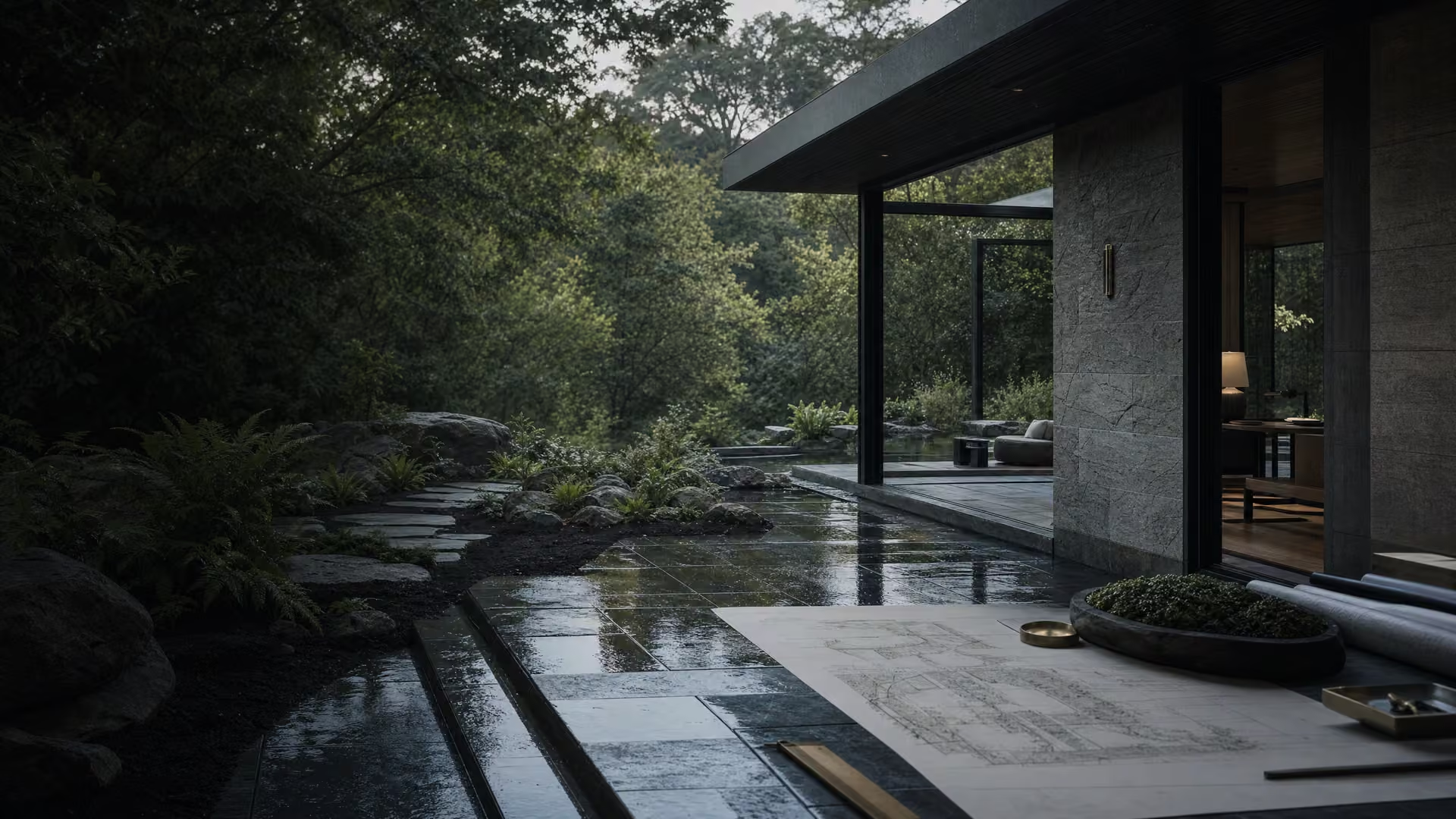
LANDSCAPING WEB DESIGN
The yard changed the property. The website should change the first impression.
Premium websites for landscape design, construction, and outdoor-living firms. Fixed at $1,995. Live in seven days.
Design-build proof separated from routine maintenance
The short answer
What is landscaping web design?
Landscaping web design is the presentation of a landscape company's work around the decisions a homeowner makes before calling: design capability, construction quality, project type, service area, reviews, and budget fit. A strong landscaping website separates high-value design-build work from routine maintenance and gives finished gardens enough visual space to communicate quality.
A finished garden cannot be reduced to one green after photo. Approach, hardscape, planting structure, outdoor rooms, lighting, and how the space settles over time all reveal the quality of the work.
The commercial architecture must also decide whether design-build, installation, maintenance, and outdoor living belong together or need separate paths. Without that distinction, high-value work gets buried under commodity search language.
A landscape is read in depth, season, and use. The site needs the same patience.
Signature inspection
A landscape is read in layers
The composition follows how a homeowner experiences the work rather than arranging photographs by file date.
- APPROACH
The first threshold
Arrival, screening, and sightline establish how the property has been reorganized.
- HARDSCAPE
The permanent structure
Stone, timber, drainage, levels, and edges prove construction judgment.
- PLANTING
Season and maturity
Structure, texture, and succession show more than a single day of green.
- OUTDOOR ROOM
How the space works
Seating, shade, cooking, water, and circulation turn a garden into a lived place.
- LIVED-IN FINISH
The work after handover
Maintenance expectations and later-season photography show how the design holds.
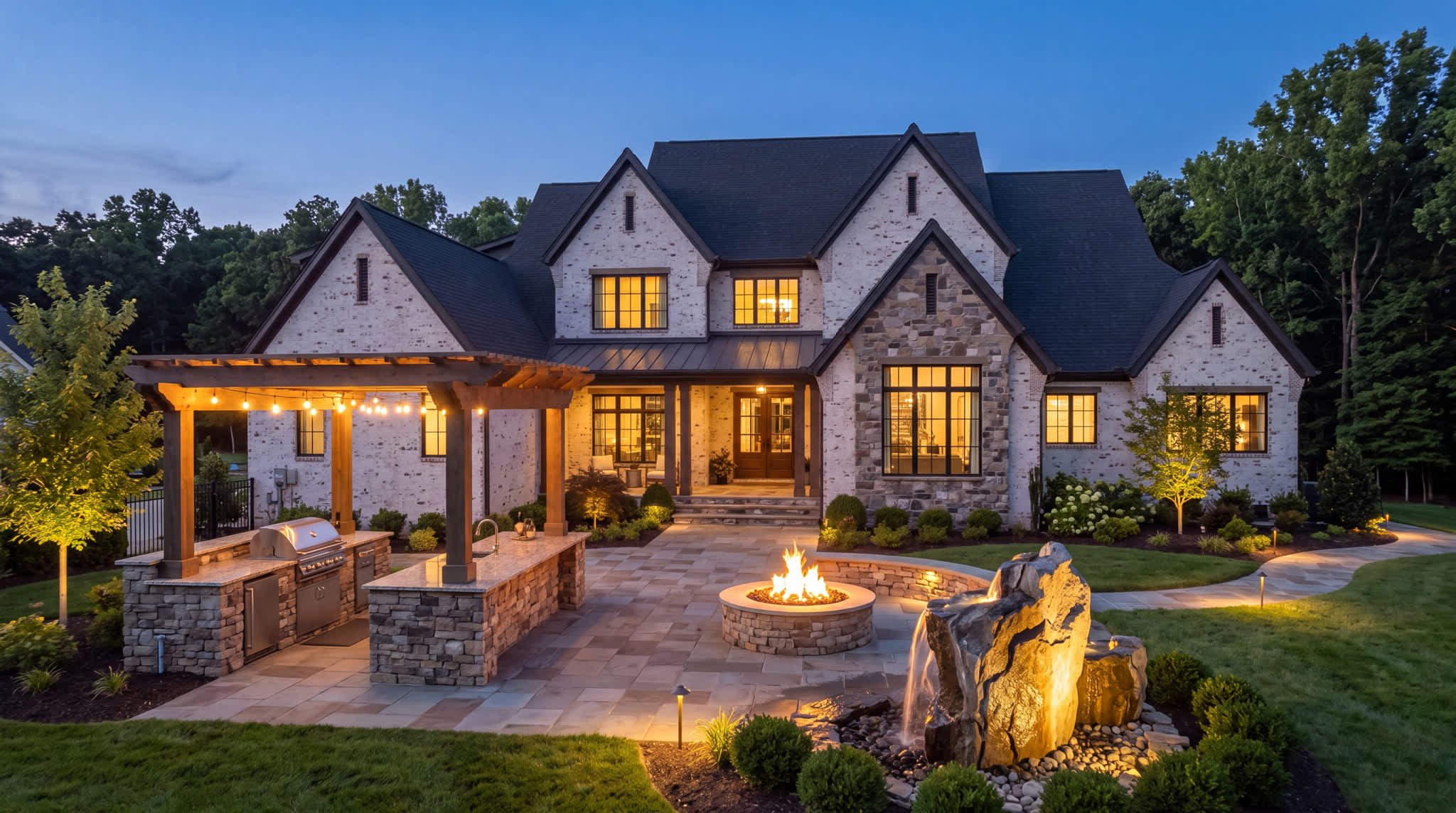
Working demonstration · Tennessee
A&S Outdoors
A truthfully labeled demonstration of an outdoor-living sales journey.
Eight dimensions
The landscape website standard
- 01
Design-build positioning
Can a buyer distinguish design-build from routine maintenance?
- Weak
- Every outdoor service has equal weight.
- Strong
- High-value design and construction lead, with maintenance clearly separated.
- Fix
- Organize the site around the work the firm wants more of.
- 02
Project sequencing
Do projects show approach, structure, planting, and use?
- Weak
- A single after image per job.
- Strong
- Each project reads as a complete spatial story.
- Fix
- Build a five-part sequence for every featured project.
- 03
Seasonal range
Does the site explain how planting develops?
- Weak
- Only peak-season green imagery.
- Strong
- Texture, structure, material, and season are represented honestly.
- Fix
- Pair establishment images with mature or seasonal evidence where available.
- 04
Service-area clarity
Can the buyer identify realistic operating geography?
- Weak
- A county-wide keyword list.
- Strong
- A precise market statement connected to logistics and project fit.
- Fix
- State the core area once and explain out-of-area fit separately.
- 05
Maintenance separation
Are recurring service and capital projects routed correctly?
- Weak
- One generic form handles everything.
- Strong
- Design-build, installation, and maintenance have distinct paths.
- Fix
- Separate intent before detailed inquiry questions.
- 06
Crew and review trust
Does proof address disruption, care, and communication?
- Weak
- Generic five-star claims.
- Strong
- Reviews speak to crews, site care, schedule, and follow-through.
- Fix
- Choose reviews that reduce the actual anxieties of landscape work.
- 07
Project qualification
Does the form establish scope, site, budget, and timing?
- Weak
- A blank quote box.
- Strong
- Project type, address area, budget, constraints, and photos are collected.
- Fix
- Ask only for information that changes the first response.
- 08
Mobile image treatment
Do layers and material details remain legible on a phone?
- Weak
- Wide garden images reduced to thumbnails.
- Strong
- Phone-specific crops and sequences preserve spatial reading.
- Fix
- Design the mobile gallery as its own edit, not a squeezed grid.
Field questions
Questions landscape firms should settle before the redesign
What should a landscaping website include?
A landscaping website should distinguish design, construction, installation, maintenance, and outdoor-living work; show complete project stories; state the real service area; publish reviews that address crews and communication; explain the process; and qualify inquiries by project type, property location, budget, timing, constraints, and photos. The best sites reveal how a plan changed circulation, levels, materials, planting, and use, rather than presenting a collection of unrelated green after images.
How should a landscaping company organize project photos?
Organize by project and sequence each story from approach through hardscape, planting, outdoor rooms, and lived finish. Include captions for useful context such as scope, materials, site constraints, and season. Keep design-build work separate from routine maintenance proof. A coherent set of eight images from one strong job is usually more persuasive than a mixed gallery of thirty images where the buyer cannot tell what changed or which details belong together.
Should landscape maintenance and design-build use separate pages?
Usually yes when both are meaningful lines of business. The buyer, proof, process, budget, and inquiry are different. Design-build needs project sequencing, spatial judgment, materials, and capital-project qualification. Maintenance needs recurring scope, service frequency, property type, and operating coverage. Separate pages prevent premium project work from being diluted by routine service language and help each buyer reach the right next step without forcing the company to hide one part of the business.
How much does a landscaping website cost?
The total depends on who supplies strategy, copy, image editing, design, build, search structure, launch, and maintenance. A DIY platform can have a low monthly fee but requires owner time and judgment. Freelancers, specialist studios, and larger agencies add different levels of service. Coxswain publishes a $1,995 fixed-scope showpiece homepage. Additional pages, photography, brand work, and ongoing search or maintenance should be compared as separate line items.
Do landscapers need a page for every town they serve?
No. A clear service-area statement is better than a set of duplicated town pages. Create a location page when there is real demand, relevant work evidence, distinct site or buyer conditions, and enough useful analysis to justify it. A page that only changes town names is not locally authoritative. It can also make the business look less credible. Use Search Console data and project reality before adding more geographic pages.
What information should a landscaping inquiry form collect?
Collect project type, property location, budget band, desired timing, current site condition, key constraints, and optional photos. If design status, access, drainage, or planning changes the fit, ask a simple question about it. Explain why the information matters and keep the form practical on a phone. Maintenance inquiries may need property size and frequency instead. The form should improve the first response without asking a serious buyer to write a full brief.
Can a landscaping website rank without a blog?
Yes. A focused site can earn visibility through strong service pages, project evidence, useful location analysis, clear internal links, accurate metadata, reviews, local mentions, and a technically sound crawlable build. A blog is useful only when the company can publish original answers, field notes, project methods, or seasonal guidance worth maintaining. Publishing generic weekly articles is not a prerequisite and can distract from the project pages and service explanations that buyers actually need.
What is the best website builder for a landscaping company?
Squarespace is a practical DIY option for a small company that values visual quality and manageable upkeep. WordPress suits a content-heavy operation with someone responsible for maintenance. Webflow offers more design control but is rarely the simplest owner-managed choice. The decision should follow content volume, visual ambition, ownership, and who will run the system. If project editing and positioning are the hard part, a specialist done-for-you build may be a better fit.
Let the property change carry through to the first impression.
One call, one direction approval, one punch-list pass. $1,995 fixed and live in seven days once the inputs are ready.
Book a call