NASHVILLE · WEBSITES FOR BUILDERS
Trusted with the house. Presented with the same level of care.
Premium websites for Nashville-area builders and contractors whose work is carried by referrals, project proof, and reputation.
Built for the market, without claiming a Nashville office
The short answer
What should Nashville builder web design communicate?
Nashville builder web design should make a contractor's level of work obvious before the first call. For companies serving high-value residential projects, that means strong project sequencing, clear service and geographic fit, specific trust signals, and an inquiry path that distinguishes a serious build or renovation from a generic quote request.
Signature inspection
Measured Southern
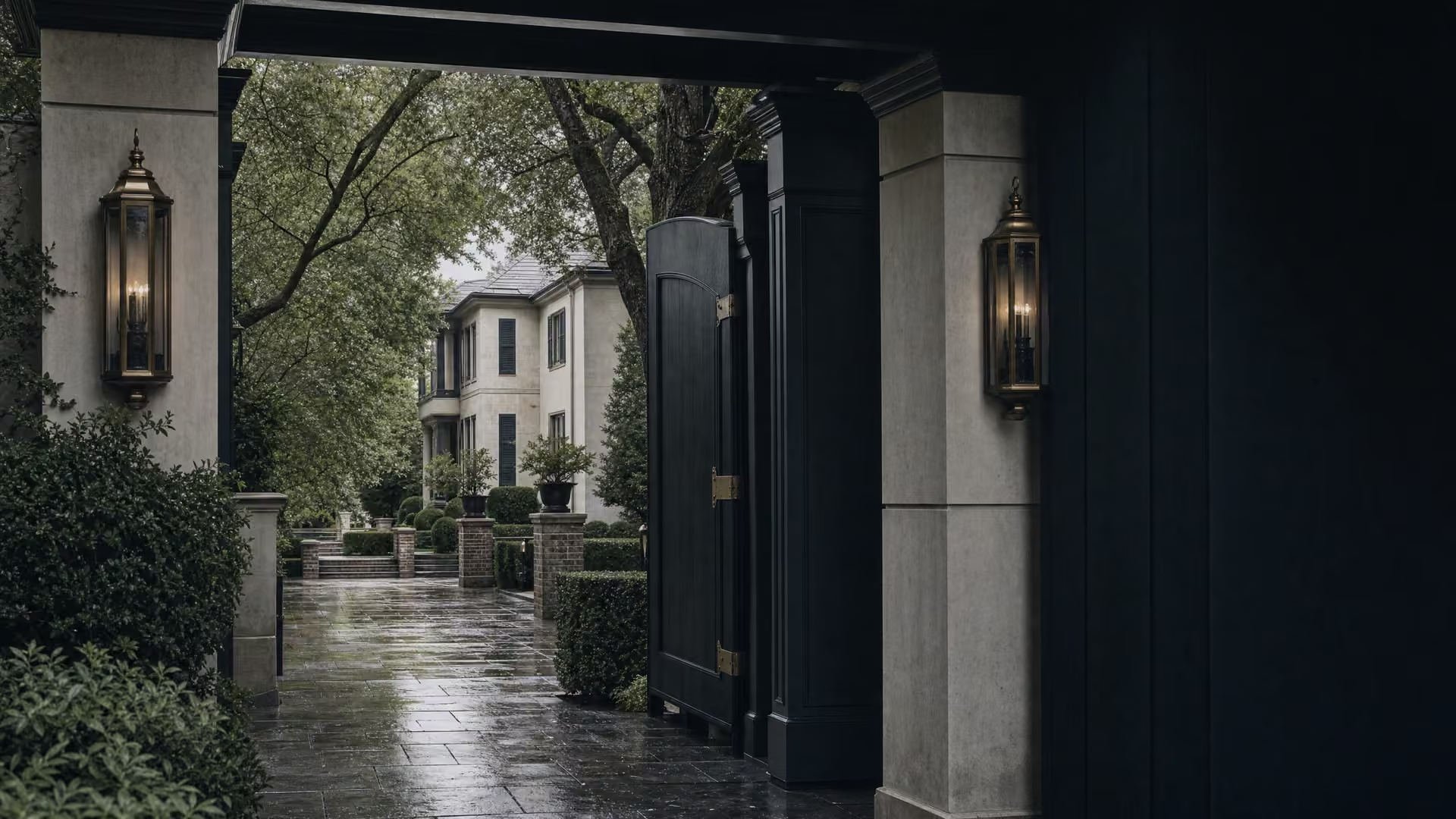
A framed threshold becomes the organizing device: approach, material, canopy, interior-exterior connection, and an inquiry built around real fit.
- APPROACH
Mature context
Canopy, drive, terrain, and neighboring architecture set the scale of the work.
- MATERIAL
Restraint over cliché
Brick, limestone, painted timber, and dark metal are shown as details, not regional props.
- THRESHOLD
Inside meets outside
Porches, terraces, gardens, and outdoor rooms prove how the property is actually lived in.
- COVERAGE
Nashville and Williamson County
The service area is precise without calling every listed community a neighborhood.
- INQUIRY
Serious project context
Type, location, budget, schedule, and readiness separate a project from a generic quote.
Local footprint
Built for the broader Nashville market
Coxswain builds websites for contractors and builders serving Belle Meade, Forest Hills, Oak Hill, Green Hills, West Meade, Brentwood, Franklin, and Leiper's Fork. These are treated as service areas within the broader Nashville market, not as eight interchangeable “Nashville neighborhoods.”
- 01Belle Meade
- 02Forest Hills
- 03Oak Hill
- 04Green Hills
- 05West Meade
- 06Brentwood
- 07Franklin
- 08Leiper's Fork
- Estate renovation, custom residential, landscape, and outdoor-living proof
- Respect for established architecture without generic Southern clichés
- Mature trees, terrain, outdoor rooms, brick, limestone, and crafted thresholds
- Clear distinction between Nashville proper and Williamson County coverage
- Trust around schedule, crews, ownership, and communication
- Project-type, location, budget, and readiness qualification
The Nashville market is not one visual or one service boundary.
Established estate contexts, mature canopy, renovation, custom residential, landscape, and outdoor-living work require careful proof without falling into a generic Southern visual shorthand.
The website should distinguish Nashville proper from Williamson County service coverage, protect client privacy, and explain crew, schedule, communication, and project fit with the same care as the finished work.
Eight dimensions
Eight checks for a Nashville builder website
- 01
Market positioning
Does the site identify the contractor's Nashville-area project fit?
- Weak
- Broad local-luxury language.
- Strong
- Specific project type, service coverage, and proof.
- Fix
- Lead with the work and operating market, not a tourism cue.
- 02
Project privacy
Are locations useful without exposing clients?
- Weak
- Exact addresses or vague city-only captions.
- Strong
- Permission-based community or broader-area naming.
- Fix
- Agree a location-label policy before publishing the portfolio.
- 03
Architectural context
Does the work respect established material and landscape conditions?
- Weak
- Generic new-build imagery.
- Strong
- Thresholds, canopy, terrain, brick, stone, and outdoor rooms are legible.
- Fix
- Show how the intervention belongs to the property.
- 04
Service boundaries
Can buyers distinguish Nashville proper and Williamson County coverage?
- Weak
- All communities described as neighborhoods.
- Strong
- The broader market and actual operating area are stated accurately.
- Fix
- Use service-area language and avoid false city-office implications.
- 05
Crew and schedule trust
Does the site answer who communicates and how work is managed?
- Weak
- A generic quality promise.
- Strong
- Named responsibility, schedule expectations, and site-care evidence.
- Fix
- Use operational proof and reviews that mention follow-through.
- 06
Referral transfer
Can the website hold the trust of a personal referral?
- Weak
- A templated first screen and stock imagery.
- Strong
- The level of real work is obvious within one phone viewport.
- Fix
- Put the strongest relevant project and precise scope first.
- 07
Project qualification
Does the inquiry distinguish a serious build or renovation?
- Weak
- A generic quote form.
- Strong
- Type, area, budget, timing, design status, and photos.
- Fix
- Ask questions that allow a useful first response.
- 08
Mobile execution
Do material, canopy, and spatial depth survive the phone crop?
- Weak
- Desktop images reduced without direction.
- Strong
- Independent mobile compositions and stable poster-first media.
- Fix
- Review every key project at 390 and 430 pixels.
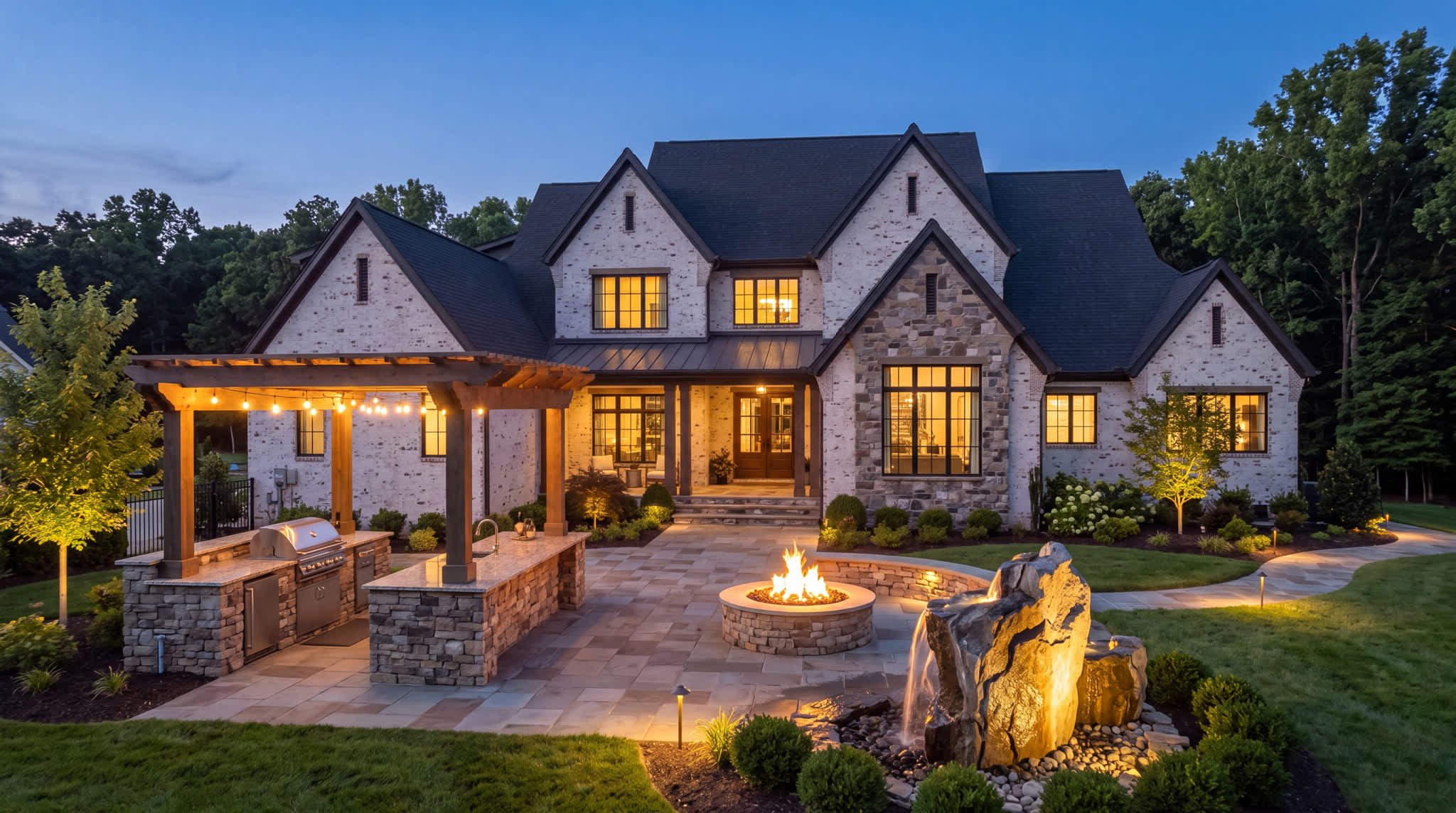
Working demonstration · Tennessee
A&S Outdoors
A truthfully labeled demonstration of an outdoor-living sales journey.
Local trust comes from accuracy, not borrowed familiarity
- Established estate and renovation proof
- Mature canopy and terrain
- Brick, limestone, timber, and dark metal
- Interior-exterior thresholds
- Landscape and outdoor rooms
- Nashville proper versus Williamson County
- Client privacy in project naming
- No physical-presence claim for Nashville
Field questions
Nashville market questions, answered precisely
What should a Nashville builder website include?
It should identify the builder's project types, real service area, project proof, process, team, reviews, and inquiry requirements. Projects should be sequenced with careful location language that respects client privacy. For high-value Nashville-area residential work, material, mature landscape, terrain, renovation context, and interior-exterior transitions often matter. The site should also distinguish Nashville proper from Williamson County coverage rather than treating every listed community as the same kind of place.
Do contractors need separate pages for Belle Meade, Brentwood, and Franklin?
Not by default. A single Nashville-market page can state coverage and provide useful local analysis. Separate pages are justified only when search demand, relevant proof, project conditions, buyer decisions, and language differ enough to create genuinely distinct resources. Belle Meade, Brentwood, and Franklin are not interchangeable labels. Duplicating a page and replacing place names adds little value and can create doorway-page risk. Expand only from verified demand and evidence.
What is the best website builder for a Nashville contractor?
The best platform follows the contractor's operating model. Squarespace is a practical DIY choice for a focused small site. WordPress fits content-heavy businesses with maintenance ownership. Webflow allows more design control but is rarely the simplest owner-managed option. A static custom build can deliver speed and control when a studio owns the implementation and handover. No platform substitutes for strong project editing, truthful service coverage, local proof, and a useful inquiry path.
How much should a Nashville contractor website cost?
There is no single Nashville price. Compare strategy, copy, project-image treatment, page count, forms, search structure, launch, hosting, maintenance, and ownership. A DIY subscription is software plus the owner's time. Studios and agencies add different levels of execution. Coxswain publishes a $1,995 fixed-scope homepage with a seven-day build window once inputs are ready. Larger project archives, photography, integrations, brand work, and search programs should be quoted separately.
How should a landscaping company serving Franklin show its service area?
State Franklin and the broader operating area in a composed service statement, then support it with real project types, logistics, and proof. Do not call Franklin a Nashville neighborhood. If the company also works in Brentwood, Leiper's Fork, or Nashville proper, describe that coverage accurately without implying an office or completed projects in each place. A location page should exist only when it can add distinct market insight and evidence beyond a changed name.
Can Coxswain build for a company without a Nashville office?
Yes. Coxswain works remotely with U.S. firms and does not claim a Nashville office. The Nashville page is built for contractors and builders serving the broader Nashville market. Coxswain's verified U.S. studio contact is in Austin, Texas. Any contractor website created for this market should state that contractor's actual office, operating area, and project evidence accurately. Remote delivery does not permit invented physical presence or borrowed local work.
How should custom builders present project locations without exposing client privacy?
Agree a location-label policy before publishing. Depending on consent, use a community, city, county, or broader market rather than an exact address. Pair the label with project type and useful site context so it still helps the buyer. Avoid implying work in a named community when the project cannot be verified. Remove identifying details from photographs and plans where needed. Privacy and local relevance can coexist when captions are specific about the work rather than the household.
How quickly can a Nashville-area contractor website launch?
Coxswain's fixed-scope showpiece homepage can launch within a seven-day build window after the current site, project photography, services, reviews, brand files, access, and feedback windows are ready. A larger portfolio or multi-page search build takes longer. The schedule depends on fixed scope and prepared evidence, not on skipping review. Coxswain can work remotely with the contractor and does not require a Nashville office or in-person studio visit.
Present the house with the same care used to deliver it.
One call, one direction approval, one punch-list pass. $1,995 fixed and live in seven days once the inputs are ready.
Book a call