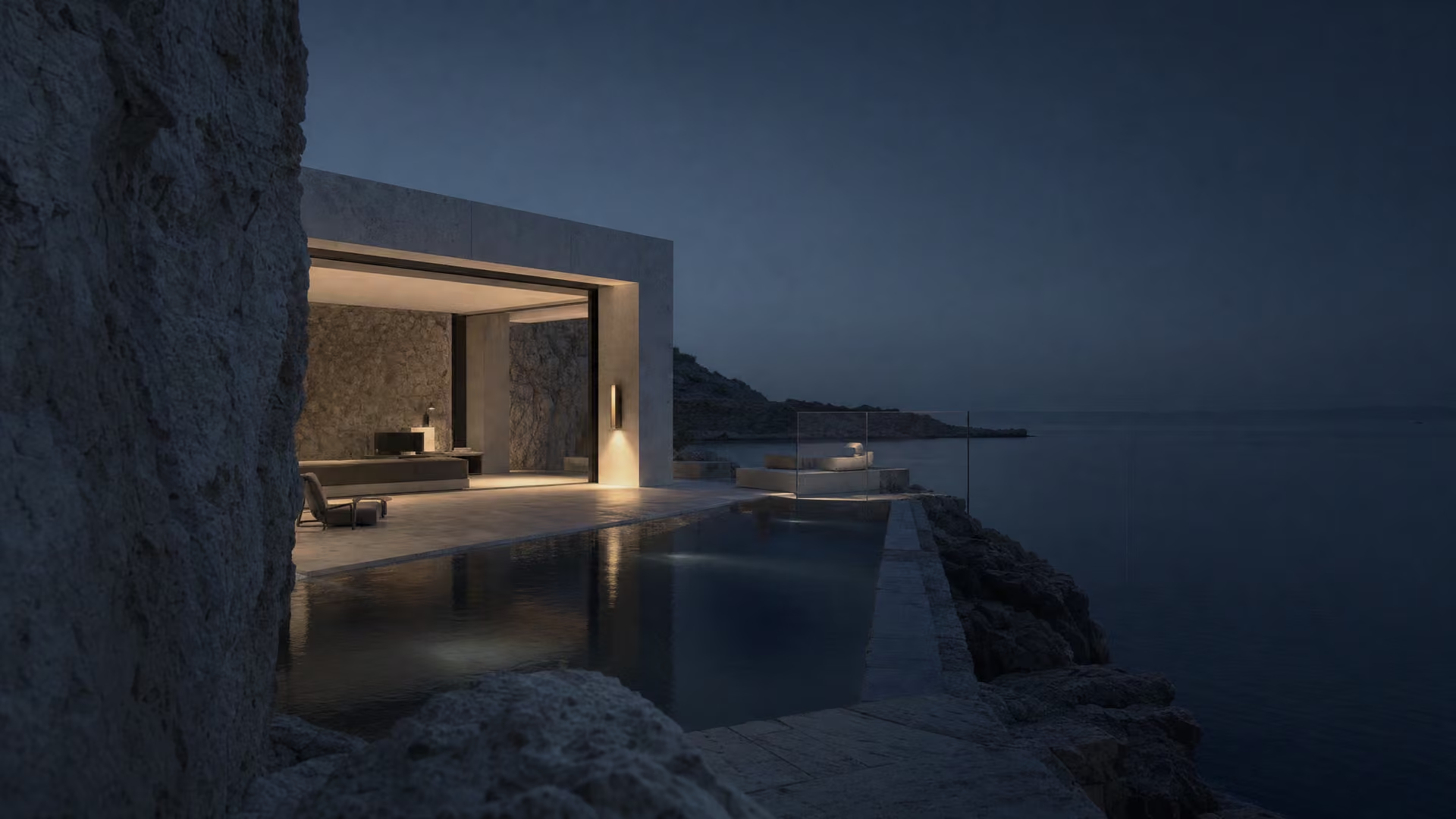
POOL BUILDER WEB DESIGN
The pool belongs in a magazine. The website should not look templated.
Cinematic websites for pool builders and outdoor-living firms selling six-figure transformations. $1,995 fixed. Live in seven days.
Water, material, setting, and scope made legible
The short answer
What should pool builder web design show?
Pool builder web design should make the finished water, material detail, setting, and project scope immediately legible. Buyers need to see whether a firm builds new pools, renovations, spas, outdoor kitchens, or complete outdoor environments; where it works; and what level of project it is equipped to deliver. The site should convert visual interest into a qualified project inquiry.
Water, stone, structure
The finished environment is the sales argument
A bright cyan rectangle tells the buyer very little. Strong pool presentation shows the waterline, coping, plaster, elevation, surrounding architecture, planting, lighting, and how the outdoor room is actually used.
The site must also separate new builds, renovations, service, and maintenance. Those buyers have different questions, different budgets, and different reasons to trust a firm.
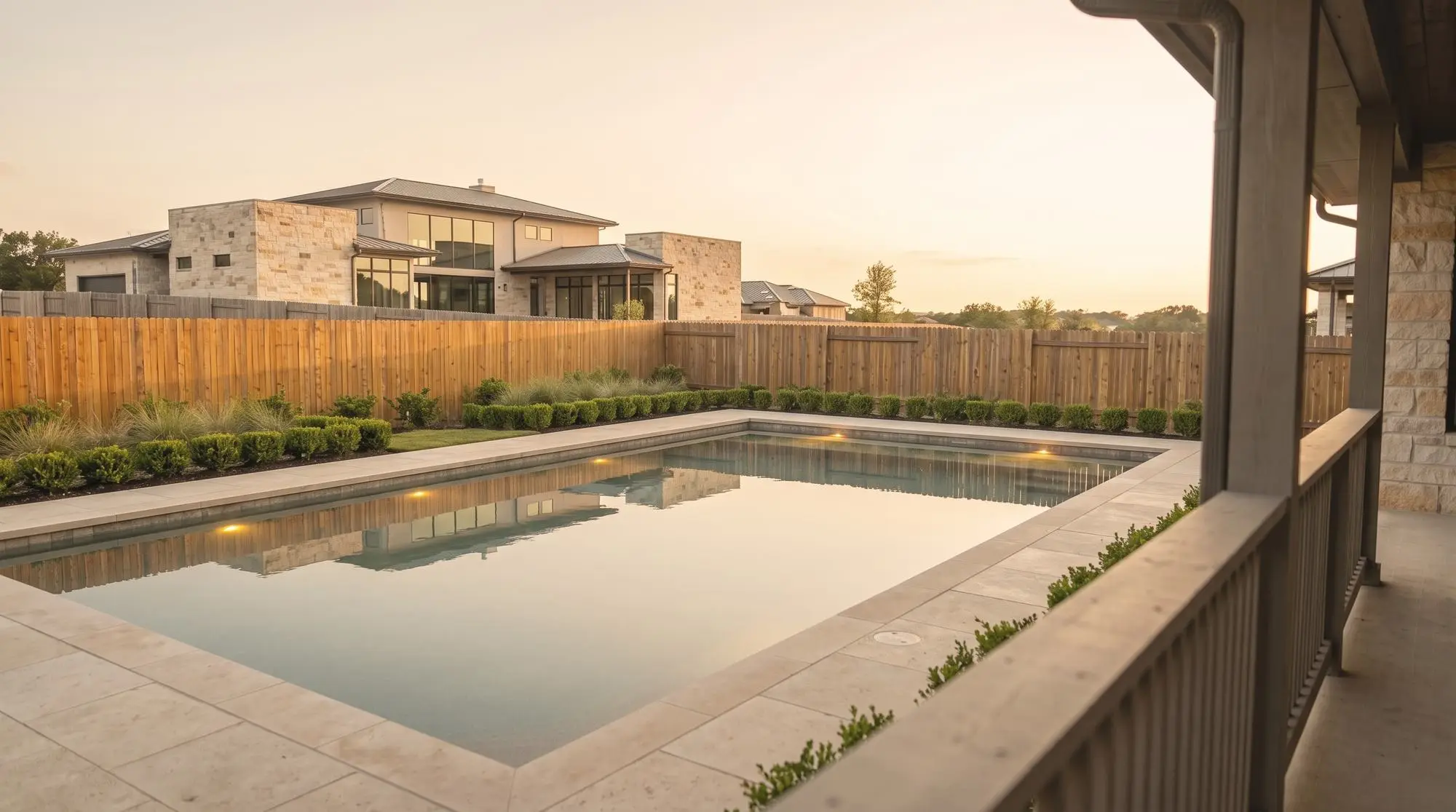
Studio showpiece · Austin pool builder
Stillwater Pools & Outdoor
Water, material detail, local positioning, and a qualified project path.
Signature inspection
The Stillwater project film, annotated
A labeled studio showpiece demonstrates how a pool project can carry both the visual argument and the qualification path.
- WATERLINE
Material before spectacle
Coping, plaster, water color, and edge treatment establish the level of finish.
- PROJECT TYPE
Scope stays visible
New pool, renovation, spa, and complete outdoor living are not collapsed into one gallery.
- AUSTIN MARKET
Place without keyword theater
Service-area language supports the work without claiming projects Coxswain did not commission.
- BUDGET BAND
The inquiry protects time
Scope, location, budget, timing, and inspiration make the first call more useful.
- PHONE
The water still reads
Independent crops, stable media, and direct controls preserve impact on a 390-pixel screen.
The buyer is evaluating the whole outdoor room
- Waterline and coping
- Plaster and water color
- Architecture and elevation
- Decking and shade
- Outdoor kitchen or living scope
- Lighting after dark
- New-build or renovation status
- Service and warranty boundaries
Eight dimensions
Eight standards for a pool builder website
- 01
Water and material photography
Can the buyer read finish quality, not just blue water?
- Weak
- Wide pool photos with clipped highlights.
- Strong
- Waterline, coping, plaster, lighting, and setting are shown deliberately.
- Fix
- Sequence one wide view with material and edge details.
- 02
Build versus renovation
Are new pools and renovations separated?
- Weak
- Every project sits in one gallery.
- Strong
- Scope and intervention are labeled clearly.
- Fix
- Add project-type structure before adding more images.
- 03
Outdoor-living scope
Does the site show what surrounds the pool?
- Weak
- The pool is isolated from architecture and landscape.
- Strong
- Decking, kitchens, shade, planting, and transitions show total capability.
- Fix
- Photograph the complete outdoor room from arrival to water.
- 04
Location and type
Can a buyer find projects relevant to their site and market?
- Weak
- No context beyond a photo.
- Strong
- Careful location and project labels explain fit.
- Fix
- Add service-area and project-type captions without exposing client privacy.
- 05
Service separation
Are maintenance and construction inquiries routed differently?
- Weak
- Every visitor receives one generic form.
- Strong
- Construction, renovation, warranty, and maintenance paths are distinct.
- Fix
- Separate intent before asking for detailed contact information.
- 06
Budget and timeline
Does the inquiry identify a viable high-value project?
- Weak
- A free-text quote request.
- Strong
- Budget band, desired completion, design status, and property context.
- Fix
- Ask for the variables that materially affect the first conversation.
- 07
Process trust
Are design, permits, construction, warranty, and communication explained?
- Weak
- A decorative three-step strip.
- Strong
- Responsibilities and decision points are explicit.
- Fix
- Publish what the client provides and what the builder owns at each phase.
- 08
Mobile visual performance
Do the images remain clear without delaying the call path?
- Weak
- Desktop crops and oversized autoplay video.
- Strong
- Poster-first media, phone-safe crops, and controlled loading.
- Fix
- Use separate mobile compositions and keep the poster as LCP.
Field questions
Pool website decisions, answered plainly
What should a pool builder website include?
A pool builder website should separate new pools, renovations, spas, outdoor kitchens, and service work; show named or clearly categorized projects; explain the design and construction process; state the real service area; publish reviews and warranty information; and qualify inquiries by project type, location, budget, timing, and design status. The strongest sites show the relationship between water, materials, architecture, landscape, and use rather than relying on a bright hero image alone.
How many pool projects should be shown?
Show enough projects to demonstrate the scopes and finish levels the business wants more of. A useful starting point is several complete project stories rather than a large mixed gallery. Each story should include an establishing view, waterline or coping detail, relationship to the house, outdoor-living context, and a night or use view when available. Remove near-duplicates. A buyer should understand range without wondering which images belong to the same job.
Should pool builders list starting prices?
A starting price or minimum project size can improve fit when it reflects the real business and is kept current. It should explain what the figure assumes and what commonly changes it, including site access, engineering, materials, structures, utilities, and outdoor-living scope. If a single number would mislead, publish budget bands or qualification language instead. The objective is to prevent obvious mismatches while leaving room for a properly scoped conversation.
How should pool renovations and new builds be separated?
Give each a clear route with its own proof, process, and inquiry questions. New-build buyers may need design, engineering, permitting, and total-yard planning. Renovation buyers need clarity on resurfacing, coping, tile, equipment, structural changes, and what can be retained. Do not bury both inside one gallery or service paragraph. Separation helps search visibility, but its commercial value is more important: the buyer sees immediately that the firm understands the relevant intervention.
What makes pool photography work well online?
Control reflections and highlights, photograph at a time when water and architecture balance, keep verticals and horizons disciplined, and include material details alongside the wide view. Show how the pool sits against the house, terrain, planting, and outdoor rooms. Avoid oversaturated cyan water and aggressive HDR. On the site, use stable dimensions, intentional mobile crops, useful captions, and a poster-first loading strategy so visual quality does not become a performance penalty.
Does a pool builder need separate service-area pages?
Only when each page can contain distinct market analysis, relevant project evidence, and useful buyer guidance. A builder serving one metro can often state its core area clearly on the main site. Separate pages become worthwhile when locations differ in site conditions, buyer expectations, approvals, architecture, or demand. Do not generate one page per suburb from the same copy. Search engines and buyers both need a reason for the page to exist beyond a changed place name.
Is Squarespace enough for a pool company?
Squarespace can be enough for an owner-managed pool company with a focused site, disciplined photography, and modest content needs. It provides a reasonable visual baseline without a heavy maintenance burden. The limitation is not simply the platform. The owner still needs positioning, project editing, copy, service structure, image treatment, and qualification logic. If those decisions are the hard part, a done-for-you studio may be the better operating choice regardless of software.
How can a website qualify a six-figure pool inquiry?
Ask for project type, property location, budget band, desired timing, design or plan status, access constraints, and optional photos or inspiration. Explain why the information helps and keep the first form short enough to complete on a phone. Publish the firm's likely scope and minimum fit before the form. Qualification should protect the buyer and builder from an unproductive first call, not make a serious prospect prove themselves through an exhausting questionnaire.
Make the water look expensive without making the site feel inflated.
One call, one direction approval, one punch-list pass. $1,995 fixed and live in seven days once the inputs are ready.
Book a call